¡Celebramos nuestro aniversario con los B-DAYS y Locura por los Importados con hasta 50% OFF!  Ver más

Enviar a
Santiago, Región Metropolitana
0
  • argentina
  • chile
  • colombia
  • españa
  • méxico
  • perú
  • estados unidos
  • internacional

Selecciona tu país

América

Europa

Resto del mundo

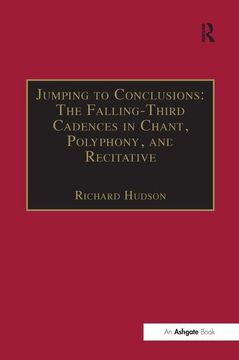
portada Jumping to Conclusions: The Falling-Third Cadences in Chant, Polyphony, and Recitative (en Inglés)
Formato
Libro Físico
Editorial
Idioma
Inglés
N° páginas
224
Encuadernación
Tapa Dura
ISBN13
9780754654070

Jumping to Conclusions: The Falling-Third Cadences in Chant, Polyphony, and Recitative (en Inglés)

Richard Hudson (Autor) · Routledge · Tapa Dura

Jumping to Conclusions: The Falling-Third Cadences in Chant, Polyphony, and Recitative (en Inglés) - Richard Hudson

Libro Nuevo Importado
Envío: 15 a 20 días háb.
$ 483.440$ 265.890
-45%
Costos de importación incluídos en el precio ✅
Libro Nuevo

Quedan 10 unidades

$ 265.890
Llega entre el 22 Sep y el 29 Sep a Santiago, Región Metropolitana. Seleccionar ubicación

Reseña del libro "Jumping to Conclusions: The Falling-Third Cadences in Chant, Polyphony, and Recitative (en Inglés)"

This book concerns the cadences which reach their conclusion by jumping from scale degree 3 down to 1 or to 1-7-1. The chronological history commences in Gregorian Chant, where the falling third is often preceded by scale degree 4, forming the striking figure 4-3-1. The cadences move, along with the borrowed chant melodies, into the polyphony of the late 14th, 15th and 16th centuries. Here, melodic figures with the shape of 4-3-1, but on any scale degree, become a significant element of style. At cadence the unbroken melodic progression 4-3-1-7-1 may lie entirely in the upper voice, or 4-3-1 may occur in a lower voice followed by 7-1 in the upper. The general effect of the falling third changes as the surrounding musical elements change and as polyphony itself evolves through time. The cadences are reborn in recitative, first in an unbroken form with 4-3-1-7-1 in the voice, later in a broken form with 4-3-1 in the voice, 7-1 in the instrumental continuo part. Many evolving rhythmic, harmonic, melodic, and other elements are important in the cadences, but two are especially significant, for they lead to difficult problems for later performers. These concern (1) the structure in which the accompaniment's V chord is notated directly below the voice's first or single scale degree 1, and (2) the possibility of an appoggiatura on scale degree 2 between the two notes of the falling third. The book suggests some new and unexpected solutions to both these problems and concludes with a brief history of the 4-3-1 figure. The book includes many musical examples by composers such as Dunstable, Dufay, Josquin, Palestrina, A. Scarlatti, J.S. Bach, Handel, Telemann, Haydn, Mozart, Schubert, Mendelssohn and Rossini.

Opiniones del libro

Preguntas frecuentes sobre el libro

Todos los libros de nuestro catálogo son Originales.
El libro está escrito en Inglés.
La encuadernación de esta edición es Tapa Dura.

Preguntas y respuestas sobre el libro

¿Tienes una pregunta sobre el libro? Inicia sesión para poder agregar tu propia pregunta.

Opiniones sobre Buscalibre

Ver más opiniones de clientes