🚀 ¡ÚLTIMOS DÍAS! ¡NOVEDADES TOP con ENVÍO A LUKA!  Ver más

Enviar a
Santiago, Región Metropolitana
0
  • argentina
  • chile
  • colombia
  • españa
  • méxico
  • perú
  • estados unidos
  • internacional

Selecciona tu país

América

Europa

Resto del mundo

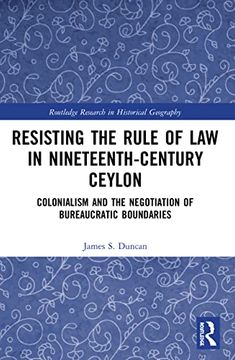
portada Resisting the Rule of law in Nineteenth-Century Ceylon: Colonialism and the Negotiation of Bureaucratic Boundaries (Routledge Research in Historical Geography) (en Inglés)
Formato
Libro Físico
Editorial
Idioma
Inglés
N° páginas
278
Encuadernación
Tapa Blanda
ISBN13
9780367515522
N° edición
1

Resisting the Rule of law in Nineteenth-Century Ceylon: Colonialism and the Negotiation of Bureaucratic Boundaries (Routledge Research in Historical Geography) (en Inglés)

James S. Duncan (Autor) · Routledge · Tapa Blanda

Resisting the Rule of law in Nineteenth-Century Ceylon: Colonialism and the Negotiation of Bureaucratic Boundaries (Routledge Research in Historical Geography) (en Inglés) - James S. Duncan

Libro Nuevo Importado
Envío: 19 a 24 días háb.
$ 145.720$ 72.860
-50%
Costos de importación incluídos en el precio ✅
Libro Nuevo

Quedan más de 100 unidades

$ 72.860
Llega entre el 13 Ago y el 20 Ago a Santiago, Región Metropolitana. Seleccionar ubicación

Reseña del libro "Resisting the Rule of law in Nineteenth-Century Ceylon: Colonialism and the Negotiation of Bureaucratic Boundaries (Routledge Research in Historical Geography) (en Inglés)"

This book offers in-depth insights on the struggles implementing the rule of law in nineteenth century Ceylon, introduced into the colonies by the British as their "greatest gift." The book argues that resistance can be understood as a form of negotiation to lessen oppressive colonial conditions, and that the cumulative impact caused continual adjustments to the criminal justice system, weighing it down and distorting it.The tactical use of rule of law is explored within the three bureaucracies: the police, the courts and the prisons. Policing was often "governed at a distance" due to fiscal constraints and economic priorities and the enforcement of law was often delegated to underpaid Ceylonese. Spaces of resistance opened up as Ceylon was largely left to manage its own affairs. Villagers, minor officials, as well as senior British government officials, alternately used or subverted the rule of law to achieve their own goals. In the courts, the imported system lacked political legitimacy and consequently the Ceylonese undermined it by embracing it with false cases and information, in the interests of achieving justice as they saw it. In the prisons, administrators developed numerous biopolitical techniques and medical experiments in order to punish prisoners' bodies to their absolute lawful limit. This limit was one which prison officials, prisoners, and doctors negotiated continuously over the decades. The book argues that the struggles around rule of law can best be understood not in terms of a dualism of bureaucrats versus the public, but rather as a set of shifting alliances across permeable bureaucratic boundaries. It offers innovative perspectives, comparing the Ceylonese experiences to those of Britain and India, and where appropriate to other European colonies. This book will appeal to those interested in law, history, postcolonial studies, cultural studies, cultural and political geography.

Opiniones del libro

Preguntas frecuentes sobre el libro

Todos los libros de nuestro catálogo son Originales.
El libro está escrito en Inglés.
La encuadernación de esta edición es Tapa Blanda.

Preguntas y respuestas sobre el libro

¿Tienes una pregunta sobre el libro? Inicia sesión para poder agregar tu propia pregunta.

Opiniones sobre Buscalibre

Ver más opiniones de clientes