Compartir
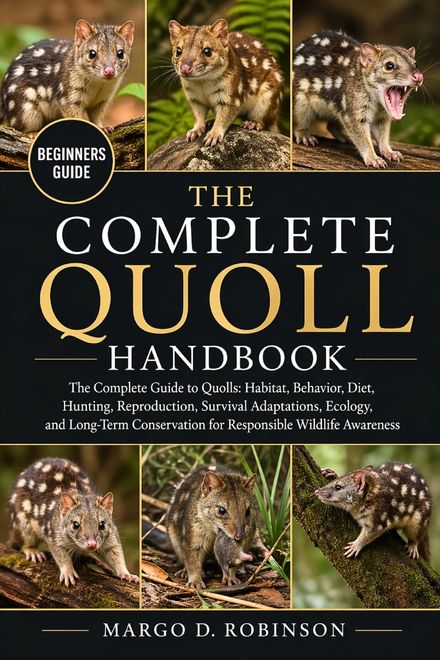
THE COMPLETE QUOLL HANDBOOK. The Complete Guide to Quolls: Habitat, Behavior, Diet, Hunting, Reproduction, Survival Adaptations, Ecology, and Long-Term Conservation for Responsible Wildlife Awareness (en Inglés)
Margo D. Robinson (Autor)
·
Independently published
· Tapa Blanda
THE COMPLETE QUOLL HANDBOOK. The Complete Guide to Quolls: Habitat, Behavior, Diet, Hunting, Reproduction, Survival Adaptations, Ecology, and Long-Term Conservation for Responsible Wildlife Awareness (en Inglés) - MARGO D. ROBINSON
Libro Nuevo
Importado
Envío: 14 a 19 días háb.
$ 56.310$ 28.160
Costos de importación incluídos en el precio ✅
Reseña del libro "THE COMPLETE QUOLL HANDBOOK. The Complete Guide to Quolls: Habitat, Behavior, Diet, Hunting, Reproduction, Survival Adaptations, Ecology, and Long-Term Conservation for Responsible Wildlife Awareness (en Inglés)"
Introduction to QuollsA Carnivorous Marsupial With a Distinct IdentityQuolls are among the most intriguing yet often overlooked animals in the natural world. Belonging to the genus Dasyurus, these carnivorous marsupials occupy a unique position within Australia's wildlife. Unlike the more widely recognized kangaroos and wallabies, which are primarily herbivorous, quolls represent a different evolutionary path-one defined by predation, agility, and adaptability.
At first glance, quolls are immediately recognizable by their spotted coats and sleek bodies. Their appearance combines features that seem familiar-resembling small cats or weasels-yet they are entirely distinct in origin and behavior. This blend of familiarity and uniqueness often leads to confusion, but it also highlights the remarkable diversity within marsupial evolution.
Understanding quolls begins with recognizing that they are not simply smaller versions of other carnivorous mammals. They are a specialized group, shaped by the environments they inhabit and the ecological roles they fulfill. Their identity is rooted in this specialization, making them one of the most fascinating examples of carnivorous marsupials.
A Lineage Defined by Evolutionary Divergence
Quolls belong to a broader family of marsupials known for their carnivorous and insectivorous habits. Within this lineage, they are closely related to the Sarcophilus harrisii, another well-known carnivorous marsupial. This relationship reflects a shared evolutionary history, where species adapted to fill ecological niches that, in other parts of the world, are occupied by placental predators.
This divergence is a result of Australia's long geographic isolation. Over millions of years, marsupials evolved independently, developing traits that allowed them to occupy a wide range of ecological roles. Quolls emerged as agile hunters, capable of navigating diverse environments while maintaining a diet that includes small animals, insects, and carrion.
Their evolutionary path highlights the adaptability of marsupials. While many people associate this group with grazing or browsing animals, quolls demonstrate that marsupials can also evolve into efficient predators, capable of sustaining themselves through active hunting and opportunistic feeding.
Diversity Within the Quoll Family
The term "quoll" does not refer to a single species but to a group of closely related animals that share common characteristics while exhibiting distinct differences. These species vary in size, coloration, and habitat preference, reflecting the diversity of environments they occupy.
Among the most recognized species are the Dasyurus viverrinus, the Dasyurus maculatus, and the Dasyurus hallucatus. Each of these species represents a variation on the same fundamental design, adapted to specific ecological conditions.